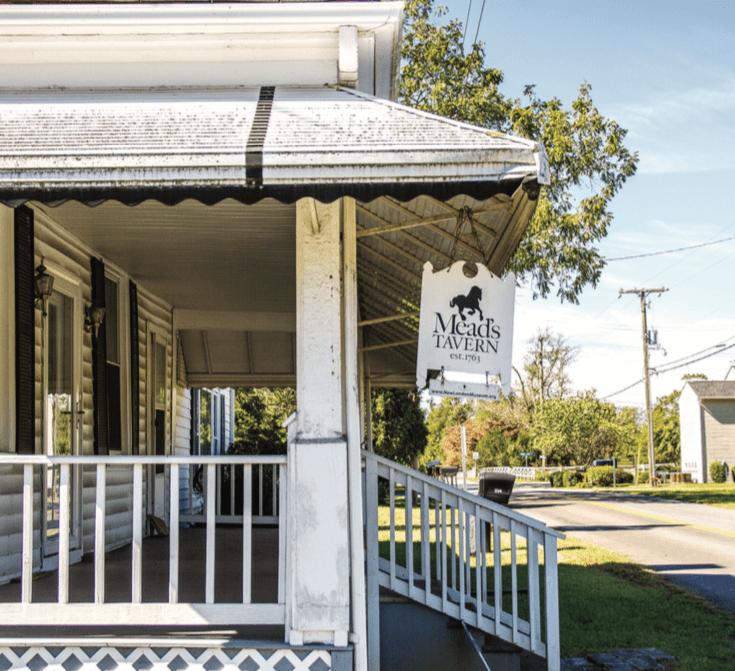
Featured

Welcome to my Historic Preservation Blog

Historic New London

After reading about and visiting the historic town of New London, I have a far greater realization of the work that it takes to preserve historic buildings and the large number of different people with different occupations that it requires. There are also different types of historic preservationists–passive, active, and professional (Tyler, 2018, 9). Historic preservation is indeed a communal endeavor.

            One of the things that I enjoyed most about New London was that there are structures from several different time periods all still standing. It is almost as if one can walk through two hundred and fifty years of the history of the town just by visiting all of the different buildings. For instance, Mead’s Tavern, the oldest standing structure in New London, and actually in the entire Lynchburg area, was built in 1763. The Bedford Alum Springs Hotel was built in the late 1910s, though there were previous buildings on the property throughout the late eighteenth and the nineteenth centuries, and the African American church was built in 1930. One can also see some of the different architectural styles of different time periods in the New London buildings.

            One of the most important groups that has been involved in preservation at New London is the Friends of New London, chaired by Randy Lichtenberger. Friends of New London is a group of local residents that formed to attempt to preserve the incredible history of their town and its historic structures and to inform others about it. Since its formation in 2008, it has acquired many of the historic structures in New London, later selling Mead’s Tavern and the Bedford Alum Springs Hotel to Liberty University. They are also attempting to acquire other historic buildings that are still privately owned. Without the Friends of New London, none of the preservation that has gone on in New London would have been possible, and many of the historic structures would have been destroyed or lying in disrepair. For example, the African American Church was being destroyed when Friends of New London was able to acquire the property. Furthermore, most people would never have been able to learn about the great historic significance of New London, especially the fact that it once housed a federal arsenal used during the American Revolution, at least according to the Wikipedia page put together by Liberty history students (https://en.wikipedia.org/wiki/New_London,_Virginia).
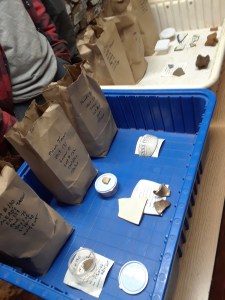
Artifacts found in the basement of Mead’s Tavern.

Another group of people vital to historic preservation is the archaeologists. According to the Mead’s Tavern Historical Structures Report, Liberty University hired archaeologists to excavate at Mead’s Tavern. Randy Lichtenberger is also very involved in the archaeology there. He has conducted substantial research on Mead’s Tavern and other buildings in New London. Incredible artifacts have been found. The archaeologists are also attempting to find the foundations of the arsenal and other buildings which are no longer standing.
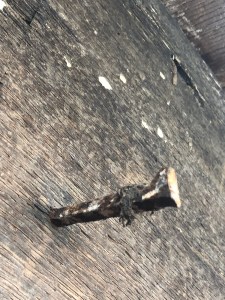
A hand wrought nail in the basement at Mead’s Tavern.

            The third essential group of people is the architectural historians. At New London, Mr. Rakes, an architectural historian, and Mr. Pezzoni, a historical (or preservationist) architect, have done extensive research on the historic buildings, particularly Mead’s Tavern. They compiled the Mead’s Tavern Historic Structures Report (http://cdm17184.contentdm.oclc.org/cdm/compoundobject/collection/p17184coll2/id/154) and the Pezzoni Bedford Alum Springs Hotel Preliminary Report (http://cdm17184.contentdm.oclc.org/cdm/singleitem/collection/p17184coll2/id/155). They have been able to identify not only which portions were built in which era, but also the materials used, down to the nails and some of the paint.

            Historic preservation teaches you to work well with others. It also, in a way, makes the past come alive and be available to the public by allowing people to actually be where historical figures were and experience what they did. William Murtagh said that “Preservation engages the past in a conversation with the present over a mutual concern for the future” (Tyler 2018, 95). The work done by historic preservationists should never be taken for granted.              

Tyler, Norman, Ilene R. Tyler, and Ted J. Ligibel. Historic Preservation: An Introduction to its History, Principles, and Practice. New York, NY: W.W. Norton and Company, Inc., 2018.
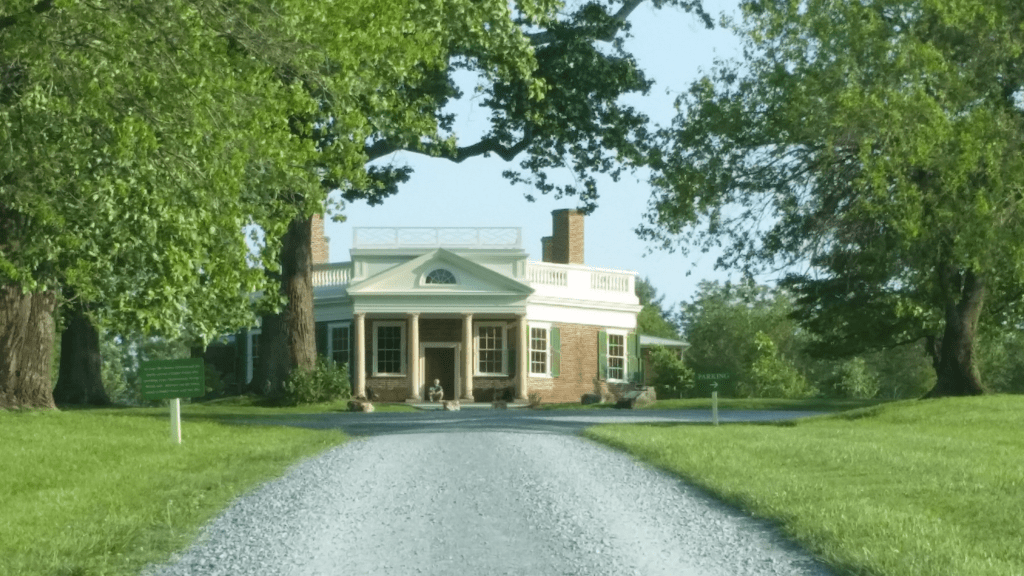
Poplar Forest: A Treasure for Historic Preservationists

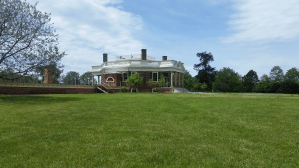
Poplar Forest. Photo by Professor Donald.

Poplar Forest served as the private retreat home of Thomas Jefferson. Though not as well known as Monticello, Poplar Forest was also designed by Jefferson himself. The estate perhaps reveals more about the man than does Monticello, due to the fact that Jefferson designed it solely for himself and his family and could thus include any features that he wanted. The process of building the house was begun during Jefferson’s presidency and was never entirely completed during Jefferson’s lifetime, though Jefferson did live there intermittently for a few years prior to his death. Poplar Forest changed hands several times and underwent many architectural changes before the process of restoration was begun. Now, it serves as one of the best examples of historic restoration in the United States.

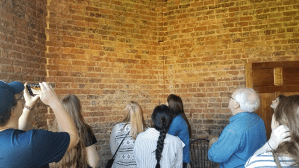
Students examining brickwork. Photo by Professor Donald.

 All four of the treatments were used in some way at the Poplar Forest site.  The house itself, however, was restored to the time of Jefferson. The landscape is being reconstructed to the same time period. Historic preservationists who have been working at the site have given great attention to detail and historical accuracy. For instance, when they needed bricks for reconstructive work, they made them from the same materials using the same methods that would have originally been used.When they restored the trim inside of the house, they hand-carved it using antique or replicas of antique tools that would have been used to originally make it. The Poplar Forest website states, “Details and materials, such as lumber, glass, lead, hardware, bricks, mortar, paint and finishes are carefully researched for site specific correctness and executed with accurate historical precision…”1 The importance that has been placed on historical accuracy at Poplar Forest is a model for all historic preservationists to follow.

Poplar Forest Landscape. Photo by Professor Donald.

Perhaps one of the greatest challenges to restoring the site was the landscaping. Archaeologists conducted extensive research and work to discover where plants may have been and what kind were planted where. This process reveals the importance of historical research for historic preservation. Fortunately, Thomas Jefferson left very detailed records of everything that he planted. However, there were still crucial details missing. The archaeologists and historic preservationists looked to landscaping styles of the time period, other projects that Jefferson had done, their archaeological finds, and even geometry and surveyor’s measurements to discover the answers. Without this research, they would never have been able to accurately reconstruct the landscape. Historic preservation cannot be done without first conducting research.

The restoration work at Poplar Forest can be used as an example of what should be done during a preservation or restoration project. It demonstrates the necessity of historical research for historic preservation. Travis McDonald states, “The quality and success of any restoration project is founded upon the initial research.”2 Furthermore, it teaches preservationists to pay attention to detail and provides a model of historical accuracy for them to follow. Maintaining the historical integrity of a site is one of the most important criteria for the preservationist. The dedication and commitment to excellence displayed by preservationists at Poplar Forest serves as an example not only for all historic preservationists and archaeologists, but for all people in every walk of life.

1 “Materials and Techniques.” Architectural Restoration. Poplar Forest Website. Accessed April 16, 2020. https://www.poplarforest.org/learn/architectural-restoration/materials-techniques/.

2 Mcdonald, Jr., Travis C. “Understanding Old Buildings: The Process of Architectural Investigation.” National Park Service Preservation Brief #35.

Downtown Lynchburg and the Academy Theatre

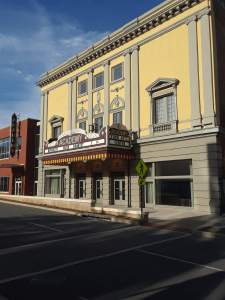
Academy Theatre. Photo by Author.

The historic Academy Theatre in downtown Lynchburg is an incredible example not only of historic preservation, but also of a community coming together to preserve a part of their history. The building was originally built in 1905, but after its closure in 1958 it fell into disrepair. According to an article entitled “Restoration of the Historic Theatre” on the Academy of Fine Arts’ website, “The theatre’s interior…is now a grim reminder of what happens when these sensitive surfaces are exposed to extreme shifts in temperature and humidity. Even the smallest holes in a roof over decades can reduce dreams to dust.”1 However, after being restored, the theatre is a magnificent, functioning structure. Downtown Lynchburg contains many other restored historic structures as well.

Academy Theatre Stage. Photo by Author.

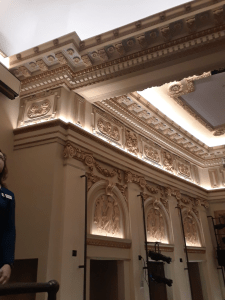
 The theatre displays all four of the treatments outlined by the National Park Service: preservation, rehabilitation, restoration, and reconstruction. Preservation can be seen in certain portions of the roof and in some of the outer brick that has been kept. Reconstruction can be seen in the rebuilt fly towers, which had fallen before restoration work had begun, and restoration can be seen in all of the artwork and sculpture that graces the inside of the theatre. Finally, the structure has been rehabilitated to be a functioning theatre once again, complete with modern safety and accessibility features. Very rarely does one find all four treatments displayed in one structure. Furthermore, the many historic structures that downtown Lynchburg holds have primarily been restored and then rehabilitated as businesses, including restaurants and hotels.

The Academy Theatre holds great historical significance as well. In its early days, it hosted several famous and important people, including people such as Billie Burke, who played Glinda the Good Witch in the Wizard of Oz. It was later converted into a movie theatre, playing films through the age of silent movies, the advent of “talkies”, and most of the golden age of Hollywood. In addition, the theatre is an example of the Jim Crow era in the South, remaining segregated until it closed in 1958. The first integrated performance in the theatre was not performed until after the reopening of the Academy Theatre in 2018.

Elaborate artwork in the Theatre. Photo by Author.

Finally, the Academy Theatre has a special place in the community. Beside the historical significance to the community, as talked about in the paragraph above, the Academy Theatre has the ability to bring people together, and not just through integration. People can connect over the history of their community, as well as over the performance of the arts. Any structure that has historical significance to a community can often draw together people of different occupations and backgrounds by uniting them in a common interest over a shared past.

Historic preservation is not simply restoring old buildings, as can be seen from the restoration of the Academy Theatre. Although that is a part of it, historic preservation also has the ability to give people a deeper appreciation of history. Further, it can bring all different sorts of people together, especially when the structure that is being restored is part of the history of a community. Historic preservation takes all kinds, not just historians and architects. It is truly a communal endeavor.

1 Art Lover. “Restoration of the Historic Theatre.” Academy of Fine Art. Accessed March 27, 2020. http://www.academyfinearts.com/restoration-project/.

Courthouse Research in Historic Preservation

After visiting the courthouses in Bedford County, Virginia and in Campbell County, Virginia, I have realized the enormous importance that courthouse records can have to a researcher, and particularly to historic preservationists. Courthouse records contain a wealth of relevant information. However, one does have to know how to search the records, as trying to find information in the thousands of records that a courthouse holds can be rather overwhelming.

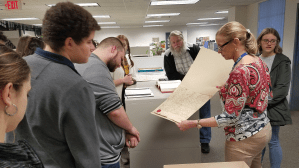
Research on a property is one of the most important steps in historic preservation. There are many resources to help preservationists begin their research, such as the publication How to Research Your Historic Virginia Property from the Virginia DHR. Yet often when people are researching, they tend to overlook courthouse records. Courthouses contain records of property deeds, wills, chancery court records, and more. Many courthouses will often hold all of the records of their particular county from the time that the county began, as long as there have been no fires or other types of destruction at the courthouse. The Bedford County Courthouse has records dating all the way back to 1754, including some documents signed by Thomas Jefferson.

Liberty students looking at a Jefferson document. Photo by Professor Donald.

Researchers can use all of these types of records to find information about people and properties. For instance, all of the transfers of the deed to Mead’s Tavern in New London, Virginia can be found in the Campbell County Courthouse. The transfers of the deed to the Bedford Alum Springs hotel can be found as well. Researchers would like to know the extent of the property at a particular time, the buildings that were on the property at that time, the worth and the function of those buildings, any additions that were made to the buildings, and, of course, who owned and who used them. Much of this information can be found in deeds and wills. Chancery court records can provide other information on the owner and others who were involved with the property and can show whether or not there were any disputes having to do with the property.

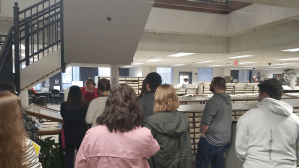
Liberty students at Bedford County Courthouse. Photo by Professor Donald.

Though these sources can be organized differently in different courthouses, the organization is often fairly similar. Both the Bedford County and the Campbell County courthouses have deed index books, which organize deeds either by the name of the grantor or the name of the grantee and the year that the deed changed hands. Furthermore, if one knows the current owner of a particular property, it is possible to trace the transfer of the deed of the property back to its original owner. Also, many courthouse records have been put online, and most courthouses have computers for people to use. In Historic Preservation: An Introduction to its History, Principles, and Practice, Norman and Ilene Tyler and Ted Ligibel state, “Digital technologies have had a profound influence on historic preservation over the past two decades.”1 Technology can make research much faster and more efficient.

When researching a historic property, courthouse records can provide essential information that cannot be found anywhere else. They contain primary sources that can prove invaluable to historic research, and these records should not be overlooked or dismissed. Courthouse research can help provide historic preservationists with the ability to piece together the events of the past and to thus give us a clearer picture of our past.

1 Tyler, Norman, Ilene R. Tyler, and Ted J. Ligibel. Historic Preservation: An Introduction to its History, Principles, and Practice. (New York, NY: W.W. Norton and Company, Inc., 2018), 226.

Vernacular Architecture and the Thompson Mill Complex

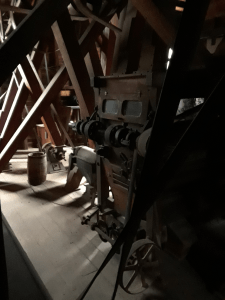
Machinery in the mill. Photo by Author.

The Thompson Mill complex sits on more than six acres in Amherst County, Virginia. There are several buildings on the property, including a mill, two houses, a barn, an ice house, and several smaller buildings. The complex was nominated for the National Register of Historic Properties and was listed as a historic property in 2019. Perhaps my favorite aspect of the property was all of the machinery still contained within the mill, which will be left intact even after the mill has been rehabilitated.

This property is a great example of the rehabilitation treatment. Rehabilitation is the process of adapting a historic structure to be used in some other way than it was originally used while still maintaining its historical integrity. In this instance, the mill itself is being converted into a restaurant and brewery, the main house will become a bed and breakfast, the ice house will be rented out for weddings and other gatherings, and the smaller house on the property will be occupied by the person in charge of the farm. On the farm, they will be growing almost all of their own ingredients for their food and beer. Yet all of the buildings will be kept in their original state as far as is possible.

This property is also an illustration of the several different kinds of people that it takes to restore a historic property. The owner, other preservationists, and even the construction workers all have a part to play. Furthermore, the owner was required to work with the local and state governments and even the road services to make necessary changes to the building. Historic preservation takes people from many very different walks of life.

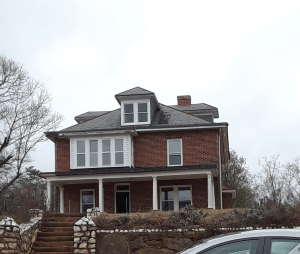
House soon to be converted to a bed and breakfast. Photo by Author.

Furthermore, historic preservation in general, and rehabilitation in particular, are in themselves forms of public history. Many people who would not study history on their own will visit a place that will actually connect them with the past. In these areas, they are able to experience for themselves what life would have been like at a certain place long ago. Furthermore, even people who would not visit a historic site as such will go to places like restaurants or breweries. Thus, they are learning and perhaps even becoming interested in history through these rehabilitated structures. Also, the area or town that the historic structure is located in, in this case Amherst, Virginia, will be positively affected by the tourism.

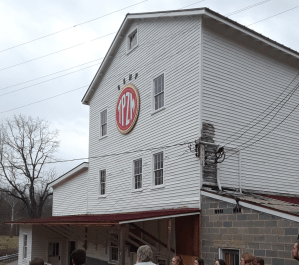
Thompson Mill with the Trapezium Brewing logo. Photo by Author.

Although the mill is considered vernacular architecture, it still shows elements of design.1 While it is not a flawless example of a particular type of style, nor was it built by a famous architect, it still holds historical value. It tells the story of those who built it, who worked there, the type of work that was done there, and thus of the culture that it was in. Vernacular buildings can often tell us as much or more about culture and society than can stylized buildings simply because ordinary people typically lived and worked in vernacular structures.

Historic structures, even those that may seem to be simply boring, everyday buildings, have much to teach us about the past. Buildings are, as far as possible, an “unmediated record” of history.2 From them, we can learn about the lives of everyday people who were humans just like we are, who faced hardships and experienced the same emotions and thoughts that we do. Historic structures have the ability to connect us with those who have gone before us.

1 Carter, Thomas, and Elizabeth Collins Cromley. Vernacular Architecture: A Guide to the Study of Ordinary Buildings and Landscapes. (Knoxville, TN: University of Tennessee Press, 2005), 13.

2 Ibid., 65.

Introduce Yourself (Example Post)

This is an example post, originally published as part of Blogging University. Enroll in one of our ten programs, and start your blog right.

You’re going to publish a post today. Don’t worry about how your blog looks. Don’t worry if you haven’t given it a name yet, or you’re feeling overwhelmed. Just click the “New Post” button, and tell us why you’re here.

Why do this?

  • Because it gives new readers context. What are you about? Why should they read your blog?
  • Because it will help you focus you own ideas about your blog and what you’d like to do with it.

The post can be short or long, a personal intro to your life or a bloggy mission statement, a manifesto for the future or a simple outline of your the types of things you hope to publish.

To help you get started, here are a few questions:

  • Why are you blogging publicly, rather than keeping a personal journal?
  • What topics do you think you’ll write about?
  • Who would you love to connect with via your blog?
  • If you blog successfully throughout the next year, what would you hope to have accomplished?

You’re not locked into any of this; one of the wonderful things about blogs is how they constantly evolve as we learn, grow, and interact with one another — but it’s good to know where and why you started, and articulating your goals may just give you a few other post ideas.

Can’t think how to get started? Just write the first thing that pops into your head. Anne Lamott, author of a book on writing we love, says that you need to give yourself permission to write a “crappy first draft”. Anne makes a great point — just start writing, and worry about editing it later.

When you’re ready to publish, give your post three to five tags that describe your blog’s focus — writing, photography, fiction, parenting, food, cars, movies, sports, whatever. These tags will help others who care about your topics find you in the Reader. Make sure one of the tags is “zerotohero,” so other new bloggers can find you, too.

Design a site like this with WordPress.com
Get started